


I had a day off. In the middle of the week. I got dressed, put make-up on and took myself into Manchester on the train. I could feel my shoulders falling away from my ears as we sped past fields, housing estates and supermarkets. As I walked towards Manchester Art Gallery, I stared up towards the gargoyles and down spouts on the imposing red brick buildings that the Victorians bequeathed us. The changing perspectives of the city as buildings are constructed, and others razed. Three sisters walking in front of me with the same build and gait and hair. I wondered if they were aware how alike they were. Inside the gallery I was really taken with a small exhibition, which led with the question: What would you leave behind for children 100 years from now?
I have been thinking about this a lot recently. My mother’s husband has just died. Technically my stepfather, but we never lived together so it feels a bit disingenuous to say that, although he has been part of my life for more than thirty years. As I plough through all the admin that comes with a bereavement, I have been questioning what we leave behind, other than online accounts. Here in the gallery hundreds of primary school children from across the city have been asked to imagine the year 2125 and their thoughts, wisdom, jokes, questions, and anecdotes have been compiled into a gift for the generations to come. It is exhibited here and will then be locked away for a century with instructions to re-exhibit in 2125 for new eyes.
Let old people sit on the bus.
Don’t laugh when someone gets the question wrong.
I hope we still have nettles because I like dodging obstacles and parkour.
It’s a simple idea, but one that we need to reflect on now more than ever. I wish that the leaders of today would ask themselves the same question, earnestly. There was a video where children shared their opinions, and it reminded me of one of my favourite documentaries directed by the late, Michael Apted (and Paul Almond) Seven Up!
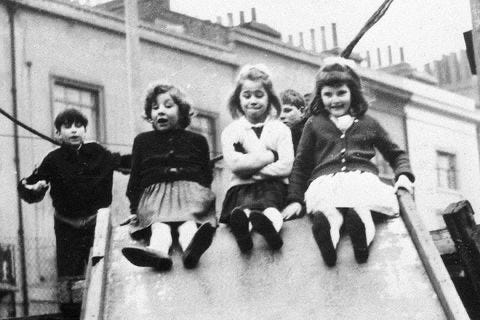
The premise of the Up series was the Jesuit saying give me a child until he is seven and I will give you the man. It follows the lives of a group of children who were put forward by their parents and teachers to take part, beginning in 1964 when they are seven years old. Watching it for the first time as a youngster it was stark how class, background and privilege defined these young people. They were selected, I’m guessing, to be representative yet there were only four females and only one child was of mixed heritage and he was in care. There was also a divide between working- middle- and upper-class kids, which really slapped you around the face in the monochrome land of Beatlemania under the government of pipe smoking Harold Wilson.
Some went to private boarding schools and others were educated at their tiny rural community village primary. The wealthier children had their lives mapped out and already knew which Oxbridge university they would attend. The working-class kids would inevitably leave school at fifteen to find work, with only a small percentage making it to further education. The aim was to see a glimpse of England in the year 2000. ‘The shop steward and the executive.’
The children were all asked questions, building a picture of their identity, challenges, hopes and quirks. I instantly fell for Neil the seven-year-old middle-class kid from Liverpool, like a young Paul McCartney, who literally skipped on to our screens and was as gentle as a lamb. When the series revisited him at 21 years-old he was living in a London squat and then more distressingly at 28 he was roaming the wilds of Scotland clearly suffering with his mental health living hand to mouth relying on social security. His journey has not been a predictable one.
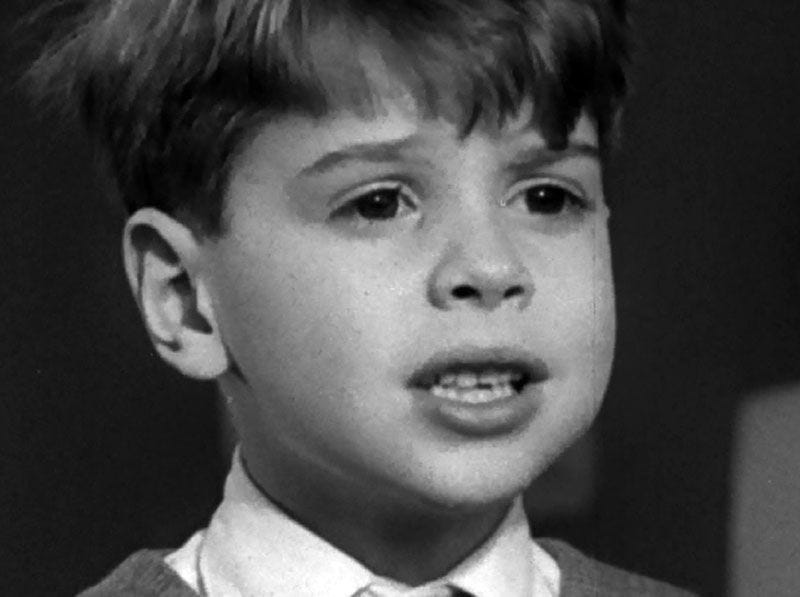
Symon, who was in care, told us of his dream where the whole world was on top of him and then it went up in the air and landed on his head. The working-class girls taking their younger siblings to school at just seven, taking on the emotional load so young. Endearing Bruce at a private boarding school shared: ‘It’s my heart’s desire to see my father,’ who was stationed in Rhodesia.
The first episode was originally filmed as a one off by Granada Television for World in Action in 1963 based on an idea by the Australian Tim Hewitt who worked for Granada, having cut his teeth at the Daily Express. Michael Apted was a recent graduate and enthusiastically put himself forward for the project as he was interested in documentary. He was partnered with the director Paul Almond who oversaw that first series. It provided a window into the state of mind of children and highlighted social injustice, which was hard to ignore when it came directly from the mouths of babes.
Due to its brilliance and huge popularity Granada Studios asked Michael Apted to continue with the series and he agreed to come back from whatever he was doing every seven years to catch up with the children as they grew up. Seven years goes to show the huge shifts that can take place for the good and the unfortunate, all set against the backdrop of a country that doesn’t offer the same opportunities for all.
Although the original programmes focused a lot on the class differences, as they grew up, it has become as much about the human condition and changes in society. Most of the children continued to be involved in various capacities with some withdrawing for a series or from the project entirely. They get paid for each episode and the crew from ITV parachutes in and films them for a couple of days. As Nick Hitchon, the Yorkshire lad from a rural community pointed out, it was like being a celebrity for an intense moment. Nick went on to become a nuclear scientist but passed away from cancer in 2023 aged 65. Lynn was the first to pass in 2013 from a short illness and Michael Apted died in 2021. It is thought the series will return in 2026 for 70 Up with a new director.
An Inheritance, the exhibition, asked visitors to consider what they would donate for the generations of 2125. On a practical level I would hope to see a tidier way of wrapping up my life so that I don’t have to leave a mountain of paperwork. I certainly do not want to be a burden to my daughter and hope that there is some kind of care system in place so that she doesn’t have to worry in the way that I feel my generation has.
‘You are the sandwich filling,’ my mother-in-law told me over dinner last week (one of them - as I naturally have two). Having two sets of ageing parents (four if you count my husbands, but his are much younger) and a teenage daughter, has been the steepest learning curve of my life and I know that my generation has had to shelve their own plans to care for family. Spending seven hours on a plastic chair in A&E as people lay on hospital beds in corridors; ploughing through red tape trying to meet individual needs; fighting for rights for children with special educational needs. All as the society that was supposed to support us collapses. I do not want this for future generations, and I sincerely hope in 2125 we are more in tune with the human and less with the bureaucrat.
Community is what I wish to donate to the exhibition. Listening to the children it is clear to me that what helps them thrive alongside love, is community. It takes a village to raise a child is perhaps the other proverb that resonates throughout the Up series. The interactions of daily life with strangers on the street, in the supermarket or on the bus. Saying sorry to your neighbours or getting them a loaf of bread when they’re ill. Sending a card to say thank you to someone who has done a good turn. Going for coffee when you know someone needs to unburden. Sharing anecdotes at work or going to the pub. As we redefine our lives through automation and our mobile phones are now our best friend, community is such a precious commodity. It is what unites us. It is how we learn tolerance and understand difference. Like reading, but in real life.
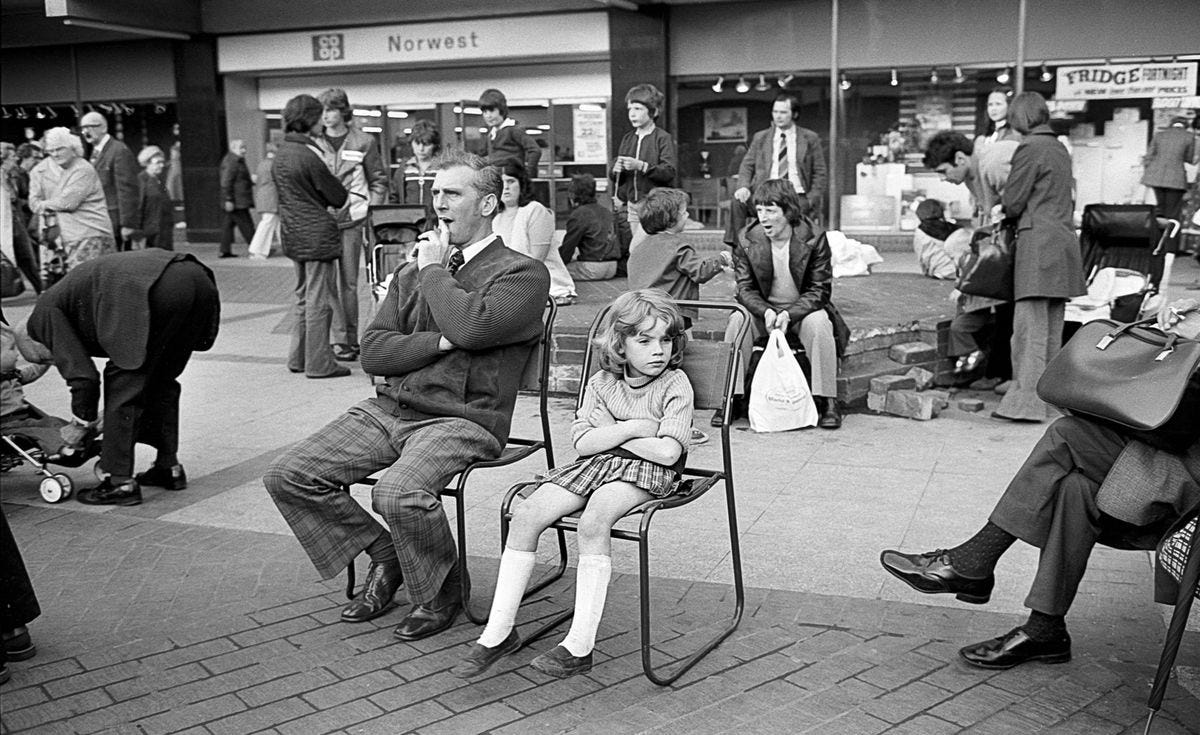
At the funeral I attended last week, I saw my uncles and cousin, who I haven’t seen for many moons. My cousin heads up London Ambulance and leads a busy life and my eldest uncle who is nearly 89, lives on his own has started going to church, not because he is especially religious but because he yearns for that sense of convergence. Society will change, but with it I hope that the isolation of modern times is reversed and that the children of 2125 understand what it means to come together.
I leave you with a joke from one of the children of An Inheritance
If you haven’t had a poo in ages you have lost the plop.
What would you donate or gift for the children of 2125?
Thank you for reading. I hope you enjoyed it. Please do hit the heart, leave a comment or consider sharing this post as it is free, it helps other people find it.
Sources
Such a thoughtful and moving piece of writing. You should take more days off! I'm the same age group as Seven Up - and it always reminds me of those I grew up with or studied with and how we have all developed. As you know, I've reconnected with many I studied with back in the 70s, and other friends from around that time. We were radicals at the time - anti-racist campaigners, alternative technology champions, etc - and the thing that gives me hope is that... we still are! Hope, creativity and a sense of agency. Those are the things I hope endure. If we can apply those things to the challenges that face us and the opportunities that technology gives us, then we can make progress. I think we will. Humanity has a welcome habit of overcoming its periodic fuck ups. I'd also gift the children of 2125 my complete collection of David Bowie records and my dog eared copy of Aneurin Bevan's 'In Place of Fear' with a note that says - "at our best, we can do this."
One day, and it will come quite soon, I’m sure, we’ll look back at that post-war period from the late-1950s up until the mid-1980s, and wonder how and why we threw it all away.
A lovely reminder, Margaret, of what we can do when we’re allowed to imagine how we can make people’s lives better. For that was what Seven Up was about, surely, as it showed all of us how we all lived in our separate and different little worlds. For only by seeing how some lived could we then make the changes that would improve their lives. Like the films of Ken Loach, and the writings of Alan Sillitoe and Shelagh Delaney, and all those others in the arts and social sciences, Seven Up was nothing if not a window on the lives of others.
And where’s the Seven Up equivalent of today? Or Saturday Night, Sunday Morning? Of course, there must be some equivalents, but they can’t possibly match the reach and influence of a programme that originated in a two channel only system.
A great reminder, Margaret, that change is never finished.
Thank you!